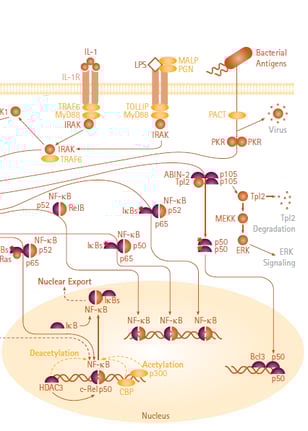
Pathways and Biomarkers of Toll-like Receptor Signaling
Understanding Toll-like Receptor Pathways and Biomarkers.
Toll-like Receptors (TLRs) are transmembrane proteins that are expressed on various immune cells. The extracellular N-terminal region of TLRs recognizes specific pathogen components. At least 13 different members of TLR family have been identified that detect different pathogen associated molecular patterns (PAMPs), including lipopolysaccharides, flagellin, bacterial CpG DNA, and viral RNA and DNA. Recognition of PAMPs by TLRs is considered as a key process for the induction of an inflammatory response.
The Toll-like receptors also work in conjunction with the complement system to provide key innate defenses. Their interplay reinforces innate immunity and regulates excessive inflammation, through synergistic as well as antagonistic interactions.
Explore the links between these pathways and the tools for the study of inflammation in this FREE downloadable poster
Interested in learning more?
Register with Lab Manager to download the poster compliments of EMD Millipore
